You've donated faithfully to your favorite charities for years. Yet when tax time rolls around, you take the standard deduction anyway—meaning all those generous contributions provide zero tax benefit. Sound familiar? You're not alone. With the standard deduction now at $31,500 for married couples and $15,750 for single filers in 2025, roughly 90% of taxpayers no longer itemize. For seniors 65 and older, the gap is even wider: the new OBBBA law added an extra $6,000 deduction per qualifying individual (subject to income limits), meaning a married couple where both spouses are 65+ could have a combined standard deduction approaching $46,000 or more. For charitable people at any age, this feels like a penalty for giving.
But there's a straightforward solution that lets you maintain your regular giving to charity while capturing real tax savings: the donor-advised fund, combined with a strategy called "bunching." This approach has become increasingly popular precisely because it solves the standard deduction problem while keeping your favorite organizations funded year after year.
What Is a Donor-Advised Fund?
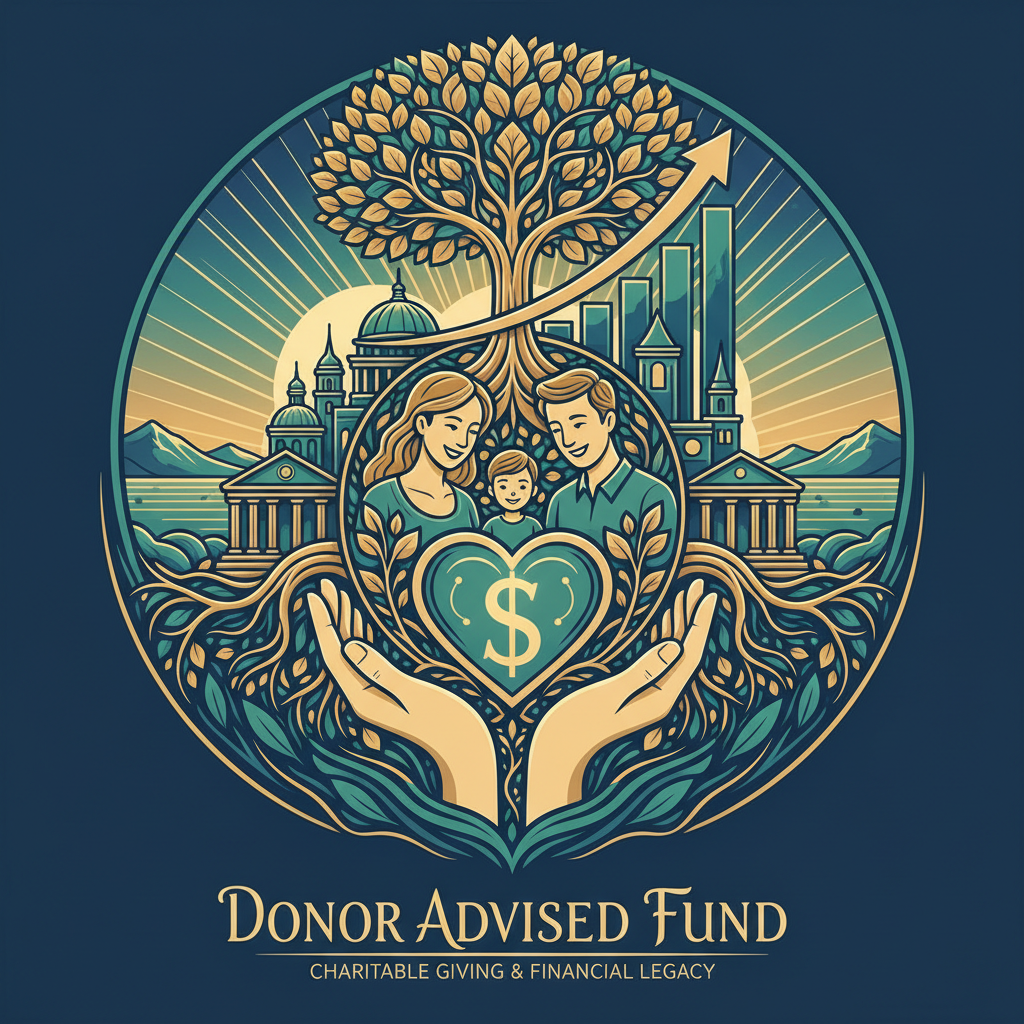
Think of a donor-advised fund (DAF) as a charitable savings account. You make a contribution to the fund—cash, stocks, or other assets—and receive an immediate tax deduction in the year you contribute. The money then sits in the account, often invested and growing tax-free, until you're ready to recommend grants to the charities you want to support. Those grants can happen immediately, next year, or even decades later.
The "donor-advised" part of the name reflects how these accounts work: you advise the sponsoring organization (typically a community foundation or a charitable arm of a financial institution) on which qualified charities should receive grants from your account. While you don't have legal control over the funds once contributed—that's what makes your contribution a completed gift eligible for a deduction—sponsoring organizations almost always follow your grant recommendations to any IRS-qualified public charity.
Several features make DAFs particularly attractive. You get immediate tax benefits without needing to decide exactly where the money will ultimately go. Your contributions can grow through investments before being granted out. You can give to multiple charities from a single account, simplifying your record-keeping dramatically. If you typically donate to ten different organizations throughout the year, that's ten receipts to track. With a DAF, you make one contribution, get one receipt, and then recommend grants whenever you choose.
The Bunching Strategy Explained
Here's where the real tax magic happens. "Bunching" means consolidating multiple years of charitable contributions into a single year, pushing your itemized deductions above the standard deduction threshold so you actually benefit from itemizing. In the off-years when you don't make large contributions, you simply take the standard deduction.
Consider the Hendersons, a married couple with $20,000 in annual non-charitable itemized deductions (mortgage interest, state and local taxes up to the cap, etc.). They typically donate $12,000 per year to their church, their alma mater, and a few local nonprofits—bringing their total itemizable deductions to $32,000. Since this barely exceeds their $31,500 standard deduction, itemizing saves them almost nothing, and their charitable giving provides minimal tax benefit.
Now imagine they bunch three years of giving into 2025 instead. They contribute $36,000 to a donor-advised fund using appreciated stock they purchased years ago for $15,000. Here's what happens:
Their $36,000 contribution is fully deductible since it's well under the 30% of AGI limit. Their total itemized deductions become $56,000 ($36,000 charitable + $20,000 other). Assuming they're in the 24% federal bracket, itemizing instead of taking the standard deduction saves them roughly $5,880 in federal taxes [($56,000 - $31,500) × 24%]. They also avoid capital gains tax on the $21,000 appreciation—saving another $4,998 (at the combined 23.8% rate). Total first-year tax savings: approximately $10,878.
In 2026 and 2027, they take the standard deduction (roughly $32,000 each year after inflation adjustments) while recommending $12,000 in grants from their DAF each year. Their charities receive the same $12,000 annual support they always have. But over the three-year period, the Hendersons deducted $120,000 total ($56,000 itemized + $32,000 × 2 standard) instead of roughly $96,000 in standard deductions—a meaningful improvement, plus the avoided capital gains.
The key insight: even though they contributed $36,000 to the DAF in Year 1, they can recommend grants throughout all three years. The charities receive steady support, but the tax benefit is concentrated where it actually helps.
Why Bunching Matters Even More in 2025
If you've been considering this strategy, 2025 represents a particularly good year to act. The One Big Beautiful Bill Act (OBBBA), signed into law in July 2025, introduces several changes to charitable deductions that take effect in 2026.
Starting January 1, 2026, a new "floor" limits charitable deductions to only the amount exceeding 0.5% of your adjusted gross income. If your AGI is $200,000, for example, only donations above $1,000 would be deductible. By itself, this floor is relatively minor for most taxpayers—but it does reduce the value of your deductions slightly.
More significantly for high earners, the new law caps the tax benefit of itemized deductions at 35% for taxpayers in the 37% bracket. A donor who previously received $37,000 in tax benefit from a $100,000 gift would now receive only $35,000 in benefit from the same contribution made in 2026 or later.
Bunching charitable contributions into 2025 allows you to avoid both of these new limitations entirely, locking in the full deduction value under current rules. If you've been thinking about a larger charitable gift or want to pre-fund several years of giving, doing so before December 31, 2025, makes particular sense.
How to Get Started with a Donor-Advised Fund
Opening a DAF is straightforward. Many financial institutions offer donor-advised fund programs, often with relatively low minimums to open an account. Your current brokerage or investment firm may already have a charitable giving arm that sponsors DAFs. Community foundations in your area also offer these accounts and often provide personalized service and local expertise. If you're unsure where to start, we can help connect you with reputable options that fit your situation.
When you're ready to contribute, you can fund your account with cash, publicly traded securities, or other appreciated assets like real estate, cryptocurrency, or interests in a closely held business. Contributing appreciated assets held for more than one year is often the most tax-efficient approach: you avoid paying capital gains tax on the appreciation and still receive a deduction for the full fair market value.
For example, if you purchased stock years ago for $10,000 that's now worth $30,000, selling it would trigger $20,000 in capital gains (and potentially $4,760 in federal taxes at the 20% rate plus the 3.8% net investment income tax). But contributing those shares directly to your DAF avoids that tax entirely while giving you a $30,000 charitable deduction. The same principle applies to appreciated real estate, crypto, or other assets—though non-cash assets other than publicly traded securities may require appraisals and have longer processing times. The charities ultimately receive more because the tax bite never happened.
Once your account is funded, you can recommend grants to any qualified public charity—including your church, local food bank, university, or national nonprofits. Most DAFs have online portals making grant recommendations as simple as a few clicks. Some even allow you to set up recurring grants to ensure your regular giving continues automatically.
Important Limitations to Know
Donor-advised funds are powerful tools, but they come with rules worth understanding.
First, contributions are irrevocable. Once you transfer assets to a DAF, you can't take them back for personal use. This isn't a savings account—it's a one-way door into charitable giving.
Second, the new above-the-line charitable deduction for non-itemizers introduced by OBBBA (up to $1,000 for single filers, $2,000 for married couples starting in 2026) specifically excludes DAF contributions. This deduction only applies to cash gifts made directly to operating charities. For most bunching strategies, this limitation is irrelevant—the whole point is to itemize in the bunching year—but it's worth noting if you're planning smaller annual gifts in your off-years.
Third, qualified charitable distributions (QCDs) from IRAs cannot go to donor-advised funds. If you're 70½ or older and want to use your IRA to make tax-advantaged charitable gifts that satisfy required minimum distributions, those distributions must go directly to operating charities, not DAFs. That said, QCDs and DAF contributions can work together in a coordinated giving strategy—you might use QCDs for regular annual giving while using your DAF for larger or less frequent gifts.
Fourth, there are deduction limits based on your adjusted gross income. Cash contributions to DAFs are generally deductible up to 60% of AGI, while contributions of appreciated assets are limited to 30% of AGI. Amounts exceeding these limits can be carried forward for up to five years.
Is This Strategy Right for You?
The bunching strategy with a donor-advised fund works best when several conditions apply. Your itemized deductions without charitable giving are within striking distance of the standard deduction—say, $18,000 to $28,000 for a married couple. You give regularly to charity and plan to continue doing so. You have the financial flexibility to make a larger contribution in one year while giving less from current cash flow in other years. And you're comfortable with the irrevocable nature of DAF contributions.
This approach may not make sense if your itemized deductions are already far above the standard deduction (in which case you're getting full benefit from your charitable deductions anyway), if you don't have cash flow to front-load contributions, or if you're uncertain about your future charitable intentions.
For many middle-to-upper-income families who give consistently to charity, however, the combination of a DAF and bunching strategy can transform charitable giving from a tax non-event into meaningful tax savings—while the causes you care about receive the same support they always have.
Take the Next Step
Year-end is the time to put this strategy into action. Contributions must be completed by December 31 to count for 2025 taxes, and transfers of appreciated stock or other non-cash assets can take time to process.
At Desert Rose Tax & Accounting, we help clients integrate charitable giving into their overall tax strategy. We can model different scenarios to see whether bunching would benefit your specific situation, help you determine the optimal contribution amount, and ensure your giving aligns with your broader financial goals.
Whether you're considering your first DAF contribution or looking to optimize an existing giving strategy, we're here to help you maximize both your charitable impact and your tax efficiency.
Edward Ethington, CPA, CFP®, MBA
Desert Rose Tax & Accounting
Your Partner in Strategic Tax Planning
(520) 747-4964
www.desertrosetax.com
This blog provides general information about donor-advised funds and charitable giving strategies and should not be construed as personal tax advice. Tax laws are complex and change frequently—particularly given the recent OBBBA changes affecting 2026 and beyond. Please consult with a qualified tax professional at Desert Rose Tax & Accounting to determine whether these strategies are appropriate for your specific situation.