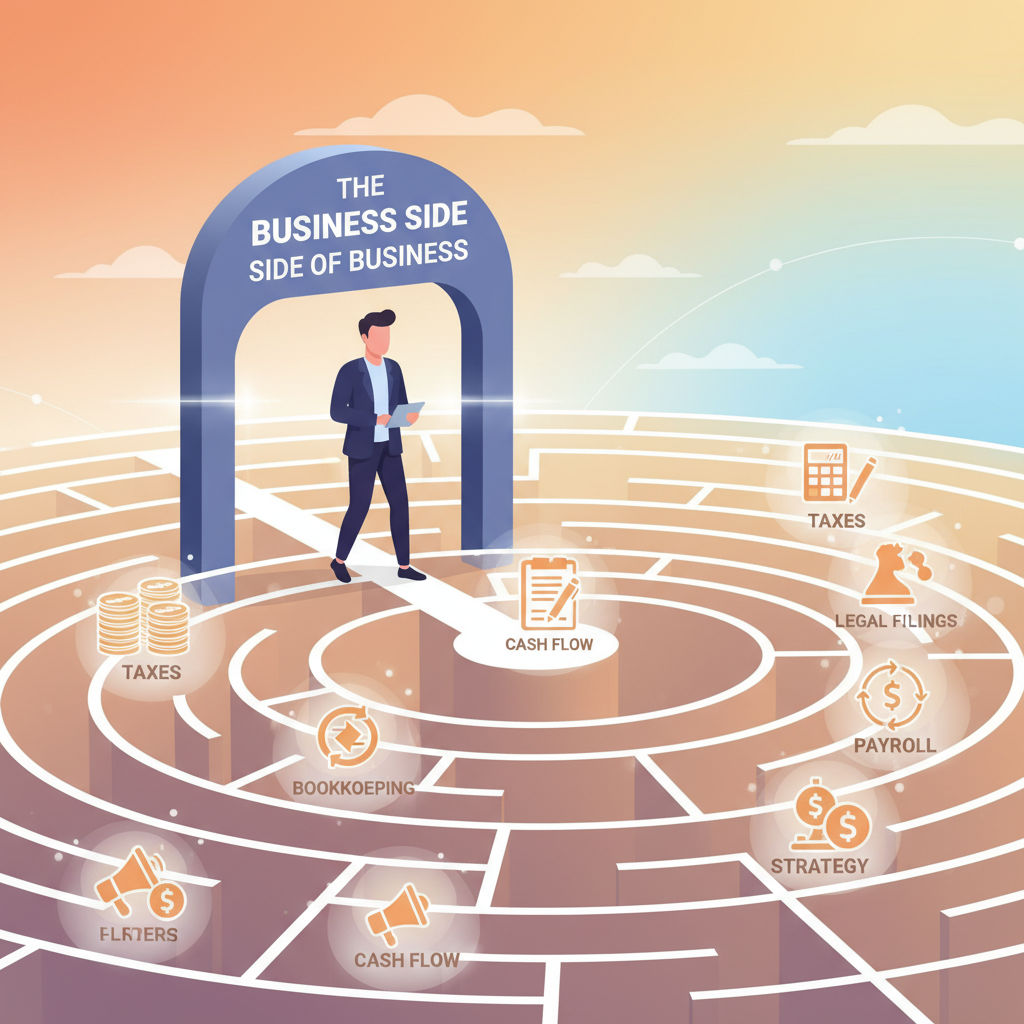
"I'll figure it out as I go." That's the most expensive business plan ever written — and we hear some version of it from nearly every aspiring business owner who walks through our door. It sounds brave and entrepreneurial. In practice, it means making critical financial decisions on the fly, discovering problems after they've already cost you money, and spending your first year reacting instead of building.
You don't need a fifty-page MBA-style document. But you absolutely need to think through a handful of critical questions on paper before you invest your savings and sign your name to anything. A business plan doesn't have to be complicated. It just has to be honest.
The Difference Between a Plan and a Fantasy
Let's get this out of the way early: a business plan isn't a pitch deck full of hockey-stick growth projections. It's not a wish list. And it's definitely not a document you write once to impress a banker and never look at again.
A real business plan is a thinking exercise. It forces you to answer uncomfortable questions before your bank account forces them on you. How much revenue do you actually need to cover your expenses and pay yourself? How will customers find you? What happens if your first three months are slower than expected? These aren't fun questions, but answering them now — when the stakes are low and you still have options — is dramatically cheaper than answering them six months in when you're burning through savings.
The plans that work best aren't the longest ones. They're the most honest ones.
What Your Plan Should Cover
You can fit a useful business plan on a single page if you're thoughtful about it. Here are the questions that matter most:
- How Will You Actually Make Money?
This sounds obvious, but "I'm going to start a consulting firm" or "I'm going to open a bakery" isn't a revenue model — it's a description. Your plan needs to get specific about how cash comes in the door. Are you billing hourly, by project, on retainer, or selling products? Will you have recurring revenue from repeat customers or contracts, or are you starting from zero every month? Is there seasonal variation you need to plan around? The revenue model shapes everything else. A business that bills hourly has different cash flow patterns, pricing challenges, and growth constraints than one that sells products or operates on subscription contracts. Getting clear on this early prevents a lot of confusion later.
- What Will You Charge — And Why?
Pricing is the single most consequential decision most new business owners make, and the most common mistake is undercharging. It happens across every industry. New owners look at what established competitors charge, shave off 20% because they feel like they need to "earn" higher rates, and then wonder why they're working sixty-hour weeks and barely breaking even. Here's what most people miss about pricing: your price doesn't just need to cover the cost of delivering the work. It needs to cover your overhead, your taxes (which are higher when you're self-employed), your benefits that you're now paying for yourself, your slow months, your unbillable time, and an actual profit margin. When you add all of that up, many new owners discover they need to charge significantly more than they expected — not because they're greedy, but because that's what it actually costs to run a sustainable business. Your CPA can help you run these numbers backward. Start with what you need to earn, add your overhead and tax obligations, factor in your realistic utilization rate (the percentage of your time that's actually billable), and that gives you a minimum price. It's not the only factor in setting rates, but it's the floor — and too many new businesses set their prices below it.
- Who Are Your Customers and How Will They Find You?"Everyone" is not a target market. The more specifically you can describe your ideal customer — what they need, where they look for solutions, what they're currently paying, and why they'd choose you over an established alternative — the more effectively you can reach them and the less money you'll waste on marketing that doesn't work. This is also where you need to be honest about sales. If you're coming from a job where the work came to you through your employer's reputation and sales team, you need a plan for how you're going to generate your own pipeline. Word of mouth is wonderful, but it takes time to build. What are you doing in months one through six while that network develops?
- What's the Competitive Landscape?
You're not starting a business in a vacuum. Other people already do what you're planning to do — or at least something close enough that your future customers consider them an alternative. Understanding what competitors charge, how they position themselves, and where there are gaps in the market isn't optional research. It's how you figure out where you fit and how to differentiate. This doesn't mean you need a formal competitive analysis with spreadsheets and matrices. It means spending a few hours looking at what's already out there with honest eyes. If five established competitors in your market charge $150 an hour and you're planning to charge $75, that's not a competitive advantage — it's a red flag that you're either undervaluing your work or misunderstanding your costs
- What Are Your Financial Projections?
This is where the plan gets real. Financial projections aren't about predicting the future with precision — they're about making sure the math works under realistic assumptions. At minimum, you need three things. First, a startup cost estimate: everything you need to spend before you earn your first dollar, including licensing, equipment, insurance, professional fees, marketing materials, and initial inventory or supplies. Second, a monthly expense forecast: rent, insurance, software, marketing, loan payments, your own salary, and the tax obligations that come with self-employment. Third, a revenue projection: how much you expect to earn per month, and how quickly you expect to ramp up. Then run the math. How many months until revenue covers expenses? How much cash do you need to survive until that happens? What's your break-even point — the amount of revenue where you stop losing money each month? If the numbers don't work under reasonable assumptions, that doesn't mean you shouldn't start a business. It means you need to adjust something — your pricing, your cost structure, your timeline, or your savings runway — before you launch. That's exactly the kind of problem you want to solve on paper, not in real life.
- What If Things Go Slower Than Expected?
Every new business plan should include a pessimistic scenario. Not because you're being negative, but because it's financially irresponsible not to. What if it takes twice as long to get your first clients? What if your first big project falls through? What if a major expense hits in month three that you didn't anticipate? Having a plan for the slow version doesn't mean you expect it. It means you survive it if it happens. The businesses that fail in year one rarely fail because the idea was bad — they fail because the owner ran out of cash before the idea had time to work.
When You Need a Formal Plan
Everything above can fit on one page. But there are situations where you need something more substantial.
If you're applying for an SBA loan, a bank line of credit, or approaching investors, they'll expect a formal business plan with detailed financials, market analysis, and management information. SBA lenders in particular have specific requirements for what a plan should include. In these cases, the plan becomes both a thinking exercise and a sales document — you're demonstrating to someone else that your business is a sound investment.
Even if you start with a one-page plan, keep in mind that you may need to expand it later as opportunities arise. Having already thought through the fundamentals makes that process much easier.
The Plan Is a Living Document
Your business plan isn't homework you turn in and forget. It's a tool you come back to — quarterly at minimum — to compare your assumptions against reality. Revenue coming in faster than expected? Great, but now you have hiring and capacity questions to think about. Slower than expected? Time to revisit your marketing, pricing, or target market before you burn through your reserves.
The best business owners we work with treat their plan as a conversation they're constantly having with themselves about whether the business is heading where they intended — and what needs to change if it isn't.
In our next post, we'll talk about investing in your business education — the books, resources, and free mentorship programs that help you build the skills business ownership demands. Because having a solid plan is the foundation, but continuously learning how to execute it is what separates the businesses that last from the ones that don't.
Take the Next Step with Desert Rose Tax & Accounting
Building realistic financial projections is literally what we do. At Desert Rose Tax & Accounting, we help new business owners turn their ideas into financially sound plans — from startup cost estimates and break-even analysis to tax projections and entity structure decisions. We'll help you run the numbers honestly so you can launch with confidence instead of crossed fingers.
Visit www.desertrosetax.com
or call (520) 747-4964 to schedule a pre-launch consultation. Let's make sure your business plan is built on real numbers, not wishful thinking.
Edward Ethington, CPA, CFP®, MBA
Desert Rose Tax & Accounting
Your Partner in Building a Business That Lasts
(520) 747-4964
www.desertrosetax.com
This blog is part of our "So You Want to Start a Business" series and provides general information for educational purposes only. It should not be construed as personal tax or business advice. Please consult with a qualified professional at Desert Rose Tax & Accounting for guidance specific to your situation.